Have an Invite Code?Click Here →

2-2-3 parenting schedule

The 2-2-3 custody schedule, in plain English — with a free template.

A 2-2-3 custody schedule gives each parent 2 days, then 2 days, then a 3-day weekend — rotating every two weeks. Here's how it works, who it fits, and a pre-built template you can start with today.

100% free — no credit card, no trial, no paywall
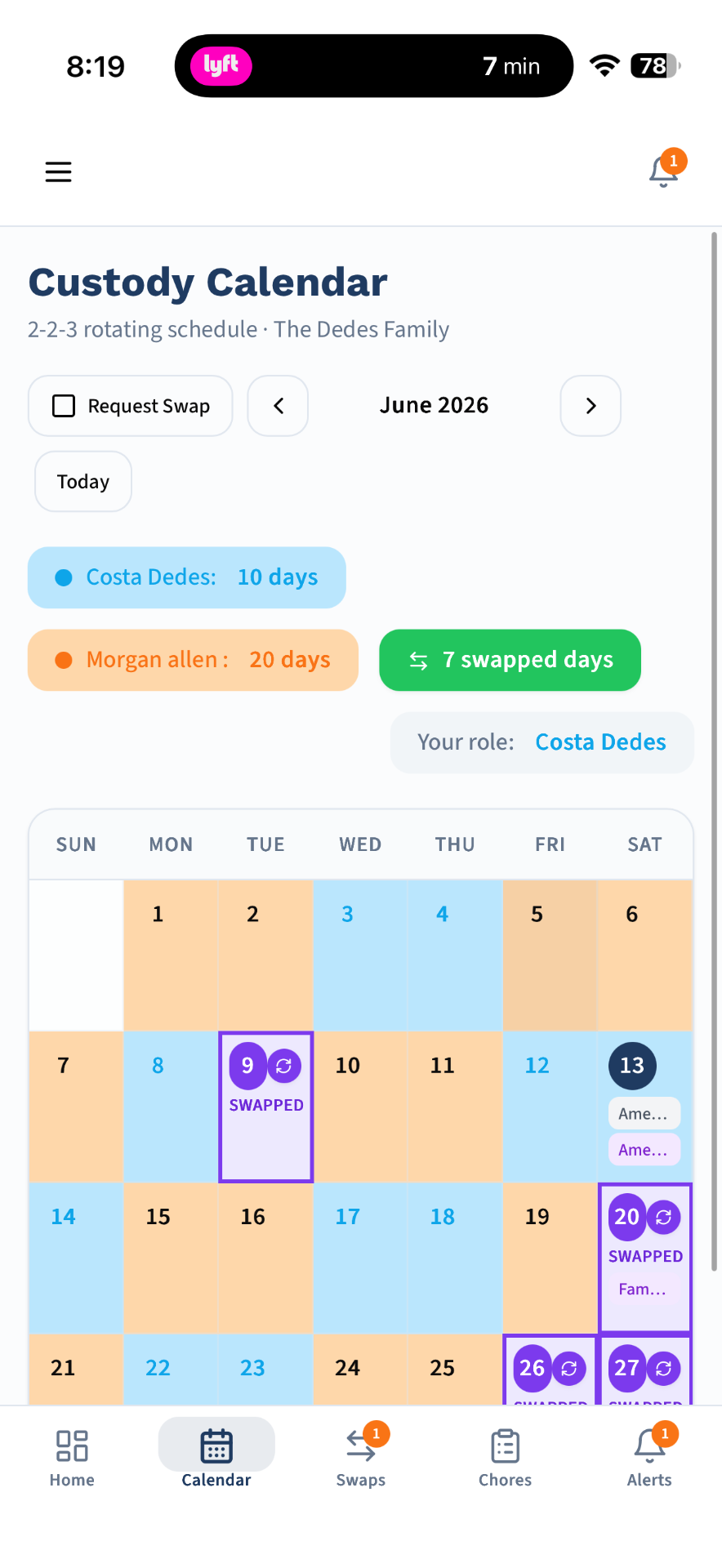
2-2-3 custody schedule shown in the CustodyTrac calendar

50/50 in a two-week cycle

Each parent gets an equal 7 nights per 14 — perfectly balanced.

Never more than 3 nights apart

The child sees both parents every 2–3 days — the point of the format.

Pre-built template, free

Pick a start date; the calendar fills itself in and alternates weekends correctly.

What a 2-2-3 schedule actually looks like

The 2-2-3 rotation (also written as "223 schedule" or "2-2-3 parenting schedule") is one of the most common 50/50 custody arrangements for younger children. It divides a two-week cycle like this:

Week 1

  • Monday–Tuesday: Parent A
  • Wednesday–Thursday: Parent B
  • Friday–Sunday (3 nights): Parent A

Week 2

  • Monday–Tuesday: Parent B
  • Wednesday–Thursday: Parent A
  • Friday–Sunday (3 nights): Parent B

The day pairs stay fixed. Only which parent has those days flips week to week — which is what gives you the alternating weekends.

2-2-3 vs 2-3-2 vs week-on-week-off

All three are 50/50 arrangements, but they trade off transitions for continuity differently:

  • 2-2-3 — 6 transitions per two weeks. Best for young kids who need frequent contact with both parents. Highest transition count.
  • 2-3-2 — 4 transitions per week. One parent gets a longer midweek stretch. A middle ground.
  • Week-on-week-off — 1 transition per week. Best for older kids and teens with heavy activity schedules. Longest stretches away from each parent.
  • 3-4-4-3 — 4 transitions per two weeks with one full week midway. Middle of the road.

Most family therapists suggest starting with 2-2-3 for children roughly under age 9, then transitioning to 2-3-2 or week-on-week-off as the child gets older and can handle longer stretches.

How to make a 2-2-3 schedule work day-to-day

The 2-2-3 succeeds or fails on the transitions. A few practices that help:

  • Keep the day pairs fixed. Parent A always has Mon-Tue; Parent B always has Wed-Thu. Teachers, coaches, and grandparents can then remember the pattern.
  • Use a shared calendar. Both parents (and older kids) should see the same source of truth so no one confuses weeks.
  • Batch handoff items. Homework folder, uniforms, medications — everything travels in one bag. Reduces "we left it at the other house" stress.
  • Do transitions at neutral spots when tension is high. School pickup, aftercare, or a grandparent's house all beat handoffs at the door.
  • Log the exchange. A quick timestamped check-in at each pickup catches recurring lateness before it becomes a fight — and doubles as a record if you ever need one.

Where the 2-2-3 breaks down

The 2-2-3 is not the right schedule for every family. Common signs it isn't working:

  • The parents live more than ~30 minutes apart — the extra transitions become the child's day.
  • The child is a teenager with a heavy activity or friend schedule — they want continuity, not more moves.
  • Handoffs are consistently tense — the extra transitions multiply the exposure.
  • One household is significantly less stable and the frequent visits are causing stress rather than reassurance.

If two or more of those apply, look at 2-3-2 or week-on-week-off. Schedules are supposed to serve the child — they're allowed to change as the child grows.

A pre-built 2-2-3 template you can use today

CustodyTrac's calendar includes a 2-2-3 rotation as a one-tap template. Pick your start date, choose which parent has Mon-Tue in week 1, and the schedule fills in the rest of the year with the correct alternating weekends. Both parents see the same calendar; swap requests, holiday overrides, and school breaks layer on top.

It's free — there's no premium tier gating the templates, and no per-parent billing. The whole point of a shared schedule is that both parents can rely on it, which they can only do if both parents actually use it.

What you get

  • 2-2-3 = 2 days, 2 days, 3 days — alternating over two weeks.
  • Equal 50/50 time between both parents.
  • Never more than 3 consecutive nights away from either parent.
  • Best for kids roughly 2–9 years old.
  • 6 transitions per two-week cycle — the tradeoff.
  • Alternating weekends built into the rotation.
  • Free pre-built template in CustodyTrac's calendar.
  • Swap requests and holiday overrides layer on top.

Frequently asked questions

What is a 2-2-3 custody schedule?
A 2-2-3 custody schedule gives Parent A the child for 2 days, Parent B for the next 2 days, and Parent A for the following 3-day weekend. The next week flips: Parent B gets 2 days, Parent A gets 2 days, Parent B gets the 3-day weekend. Over a two-week cycle each parent has equal time (50/50) and the child never spends more than three consecutive nights away from either parent.
What ages is the 2-2-3 schedule best for?
The 2-2-3 schedule is most commonly recommended for younger kids (roughly ages 2–9) because it minimizes stretches away from either parent. Older kids and teens usually prefer week-on-week-off or a 2-2-5-5 rotation because the extra transitions in a 2-2-3 can interrupt homework, activities, and social plans.
What does a 2-2-3 custody schedule look like on a calendar?
Week 1: Mon-Tue with Parent A, Wed-Thu with Parent B, Fri-Sun (3 nights) with Parent A. Week 2: Mon-Tue with Parent B, Wed-Thu with Parent A, Fri-Sun (3 nights) with Parent B. Then it repeats. The days themselves stay fixed (Mon/Tue, Wed/Thu, Fri-Sun) — only which parent has those days alternates.
How is 2-2-3 different from 2-3-2 or 3-4-4-3?
2-2-3 rotates in a two-week cycle with a 3-day weekend that alternates. 2-3-2 keeps Parent A on Mon-Tue and Parent B on Wed-Thu-Fri while the weekend swaps — fewer transitions but longer midweek stretches. 3-4-4-3 is a 2-week rotation with 3 days then 4 days each, giving each parent one full week midway. All three are 50/50; they trade transitions for continuity in different ways.
Is a 2-2-3 schedule good for the child?
For younger children whose attachment needs frequent contact with both parents, yes — 2-2-3 is often the developmental recommendation. The tradeoff is transitions: 6 handoffs per two-week cycle instead of 2 on a week-on-week-off. If both households are close geographically and transitions are calm, this is manageable. If pickups are a two-hour drive or emotionally charged, the extra transitions can wear on the child.
How do we make a 2-2-3 schedule work with school and activities?
Keep the day pairs consistent (Mon-Tue always the same parent, Wed-Thu always the other). This lets teachers, activity coaches, and playdate parents predict who to contact. Use a shared calendar both parents can see, and put activities and school pickups on the same calendar so whichever parent has the child that day knows the full day at a glance.
Where can I get a free 2-2-3 schedule template?
CustodyTrac has a pre-built 2-2-3 rotation template in its custody calendar. You pick your start date, invite your co-parent, and the schedule generates automatically with the correct alternating weekends. It's free — there's no premium tier gating templates.
Free for both parents. Forever.

Every CustodyTrac feature is available at no cost. No paywalls, no upsells, no locked reports.

Create your free account